Water Heater Service & Installation
Paso Robles water is hard, and hard water is brutal on water heaters. Scale insulates the burner from the tank, the unit works harder, and a heater that should have lasted twelve years quits at seven. Here's how we get you more than that.
Repair or replace?
We don't have a rule that says every heater over eight years old gets replaced. What we do is look at four things: the age, the condition of the tank, what's actually failed, and what the repair costs against a new unit.
Usually worth repairing: a bad thermocouple or igniter, a failed gas control valve on a newer unit, a leaking T&P valve, a burned-out heating element, a bad thermostat, or a failed anode rod on an otherwise healthy tank.
Usually worth replacing: a tank that's leaking from the shell itself — that's rust from the inside out and there's no fixing it — a heavily scaled unit past ten years, or a repair quote that's getting close to half of a new install.
We'll give you both numbers and let you make the call.
Tank water heaters
A conventional tank is still the right answer for a lot of homes. It's less expensive up front, it's simpler to service, and if your gas line and venting are already sized for it the install is straightforward.
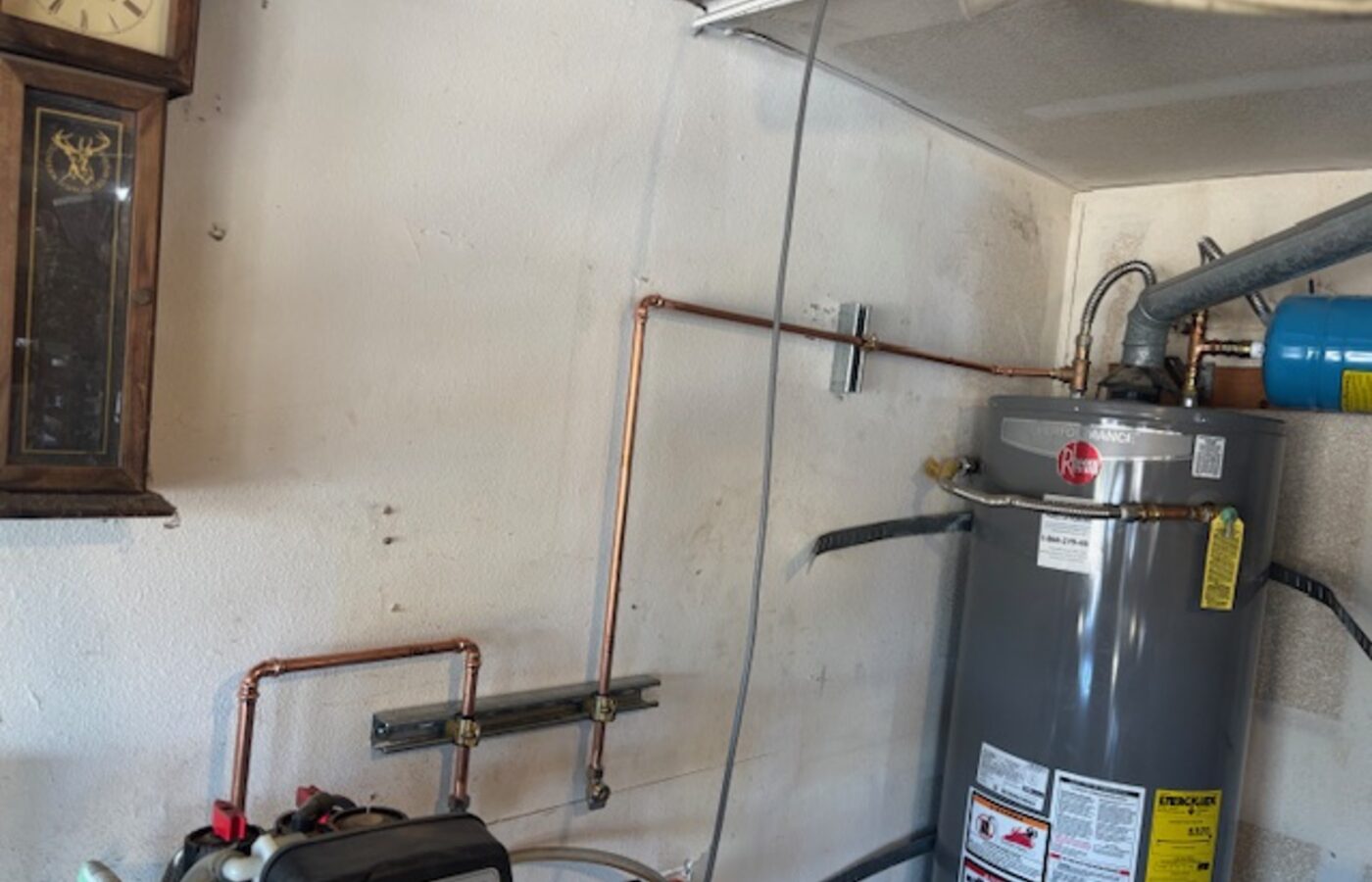
What we do differently on a tank install: we set the unit on a proper stand where code requires it, we install a new expansion tank if you're on a closed system, we replace the flex connectors and the shutoff rather than reusing tired ones, we strap it correctly for seismic, and we make sure the T&P discharge terminates where it's supposed to. Corners get cut on all five of those and it's the reason so many replacements fail early.
Tankless conversions
Tankless is genuinely great when it fits: endless hot water, a much smaller footprint, and a service life that can run twice a tank's. But it's not a drop-in swap, and anybody who quotes it like one is going to hand you a change order later.
A proper conversion usually involves:
- Gas line sizing — a tankless unit can demand 150,000–199,000 BTU where your tank used 40,000. That often means upsizing the line back to the meter.
- Dedicated venting — stainless or PVC depending on the unit, run to a code-compliant termination
- Condensate handling — on condensing units, neutralized and drained properly
- Isolation valves — so the unit can actually be flushed, which on our water matters enormously
- Electrical — a dedicated circuit for the controls
We quote all of it up front. No surprises halfway through.
Hard water is the real enemy
This is the part most companies skip. Groundwater across the North County runs hard, and every degree you heat it accelerates scale dropping out of solution and onto your heat exchanger or tank bottom.
What actually helps: flushing the tank annually instead of never, replacing the anode rod at the halfway point of the warranty rather than after it fails, keeping the thermostat at 120°F instead of 140°F, and on tankless, descaling on a real schedule. If your water is particularly aggressive we'll talk to you about treatment — not because we're trying to sell you one, but because it's usually cheaper than replacing appliances early.
Water Heaters FAQs
Can you replace my water heater the same day?
Often, yes — standard-size gas and electric tanks are common enough that we can usually source one and get it in the same day. Tankless and oversized units typically need to be ordered.
Do I need a permit to replace a water heater?
In most jurisdictions here, yes. Replacement triggers current code requirements — seismic strapping, expansion tank, T&P discharge, venting, and drain pan among them. We pull the permit and handle the inspection. It matters at resale, and it matters to your insurance if something goes wrong.
How long should a water heater last around here?
A tank that's flushed annually and has its anode rod replaced can reasonably see 10–15 years. One that's never touched on our water often quits between 6 and 9. Tankless, maintained, can run 20 — but neglected tankless on hard water scales up fast.
Is tankless worth it?
It depends on your household. If you run out of hot water regularly, want the space back, or plan to stay in the house a long time, the math usually works. If your tank is fine and you're just replacing at end of life, a quality tank is often the better value. We'll give you an honest read on your situation rather than push the bigger ticket.
Other services
Drain Cleaning
Slow drains, backed-up sinks, and stubborn main-line clogs cleared with cable machines, hydro-jetting, and camera confirmation.
Learn moreRepiping & Water Lines
Galvanized, polybutylene, and failing copper replaced with PEX or copper — planned around your household, not the other way around.
Learn moreLeak Detection
Slab leaks, under-sink drips, irrigation losses, and mystery water bills — located precisely before anything gets opened up.
Learn moreNeed a plumber who picks up the phone?
Call and talk to someone who actually does the work. We'll tell you what's wrong, what it costs, and when we can be there.